 Master Touch
Outside of team practice, most kids benefit from short daily ball work: 10–15 minutes for ages 6–9, 20–30 minutes for ages 10–12, and 30–60 minutes for serious teens. Frequency beats duration — five short sessions a week build more skill than one long one.
The principle: frequency beats duration
Motor learning research and every experienced coach agree on this: skills consolidate through repeated, spaced exposure. Six 10-minute sessions build touch better than one 60-minute session, because each new session forces the brain to re-retrieve and strengthen the pattern. Marathon sessions mostly train fatigue.
This is great news for busy families. You don’t need to find an hour. You need to find ten minutes, most days, and defend them.
Age-by-age guide
Ages 5–7: play, don’t train
At this age “practice” should look like play: kicking against a wall, dribbling around the dog, knocking over water bottles. 5–10 minutes of ball play a few times a week is plenty. The only goal is that the ball stays fun.
Ages 8–9: the habit window
This is where a daily rhythm first becomes possible. 10–15 minutes a day of simple footwork — toe taps, foundations, cone dribbles (see at-home drills) — is ideal. A parent usually logs the sessions and celebrates the streak. Kids this age love watching a number grow more than adults expect.
Ages 10–12: ownership
20–30 minutes a day, and critically, the player starts to own it: their goal, their streak, their leaderboard spot. This is the prime age for the 1,000 touches a day habit — it fits in 15 minutes and produces obvious results within weeks.
Ages 13+: intent
Serious teen players push to 30–60 minutes with real intensity — tempo matters as much as volume now (training at game speed, not strolling). Rest days become deliberate rather than accidental. Players chasing the next level scale toward 2,500–5,000 touches on big days.
The consistency problem (it’s not a discipline problem)
Most families don’t fail at soccer practice because kids are lazy. They fail because practice is invisible: no record, no streak, no scoreboard, so skipping is free. Make the work visible and skipping suddenly costs something.

Make every session count with Master Touch
Set an age-appropriate daily touch goal, log sessions with the timer or in ten seconds afterward, and let the streak protect the habit. Weekly charts show consistency at a glance, the tempo score tells older players whether they trained at game speed, and team leaderboards turn daily ball work into a friendly rivalry. Free on the App Store, built for players and parents.
Download Free on the App Store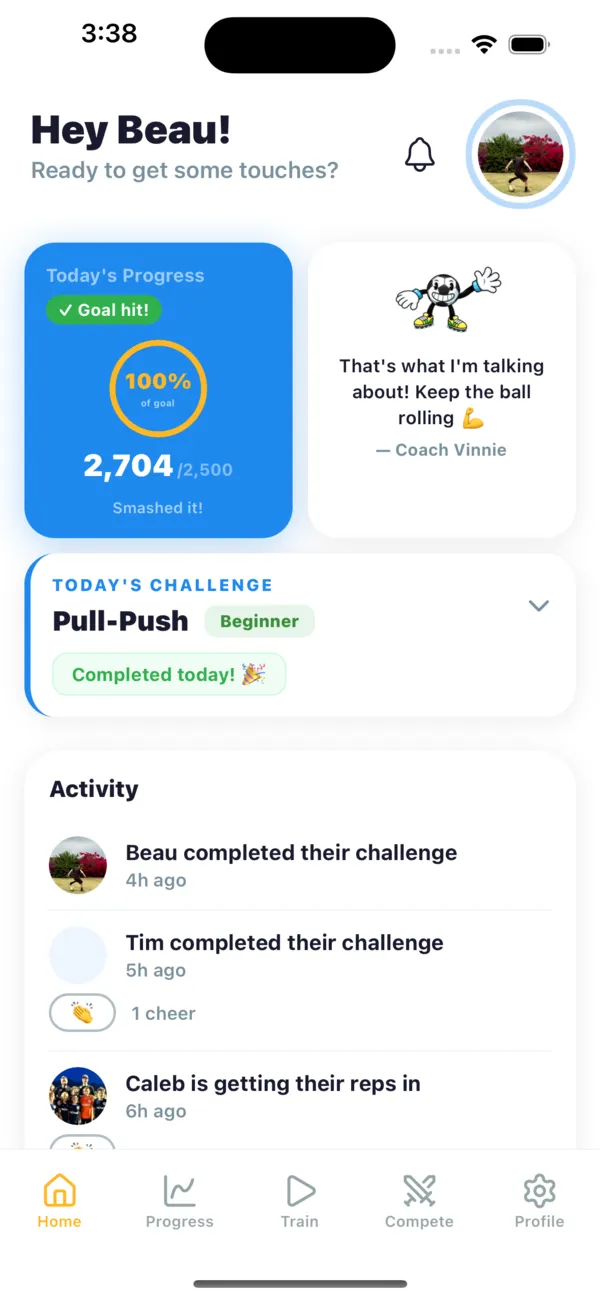
Signs you’ve got the balance right
- The kid sometimes starts without being asked (streaks make this happen shockingly fast).
- Sessions end with energy left over — wanting more tomorrow is the engine of consistency.
- The weekly chart is mostly full, not perfectly full. Perfection is a parent goal, not a kid goal.
- Game-day touch looks calmer. That’s the whole point showing up.
And if motivation dips anyway — it will — here’s how to restart it without nagging.